Why do we love clicking buttons
Pressing a button you already know takes about two and a half seconds. That is not an opinion. Three researchers put a stopwatch on it in 1980: 1.35 seconds to think, 1.1 to point, a fraction more to click.1
I should have looked that number up before starting a company against it.
A personal manager
Outter came straight out of selling Hattl. The idea was easy to say. Every product is a pile of screens, and behind every screen there is an action: change the address, pause the plan, get the invoice. We built AI co-pilots that lived inside a product and turned every one of those actions into a conversation. You say what you want, it does it. Every customer gets a personal manager, the kind that used to come only with the biggest accounts.
We were quick about it. The first version was live in under sixty days, and a fully AI-native app followed in under four months. Revenue reached five figures in eight weeks. One headline called us a “Shopify for AI features,” which I enjoyed more than I should admit. One client, a European food-tech company, cut its onboarding time in half by swapping its sign-up flow for a conversation.2
It demoed beautifully. A sentence goes in, and something that used to take six screens just happens.
Under the hood
The thing people saw was one chat window. Behind it was an orchestration engine: a router that works out what the person actually wants, hands each part of the job to whichever specialized model is good at it, and speaks back in the client’s own tone of voice.2 Several models, one voice, and none of the machinery visible.
The design decision I would defend anywhere is that it did things. Most assistants of the time answered questions about the product. Ours pressed the buttons. Change the price, update the listing, move the delivery, onboard the new user. I used to describe it in one line: a chatbot tells you how, this just does it.17
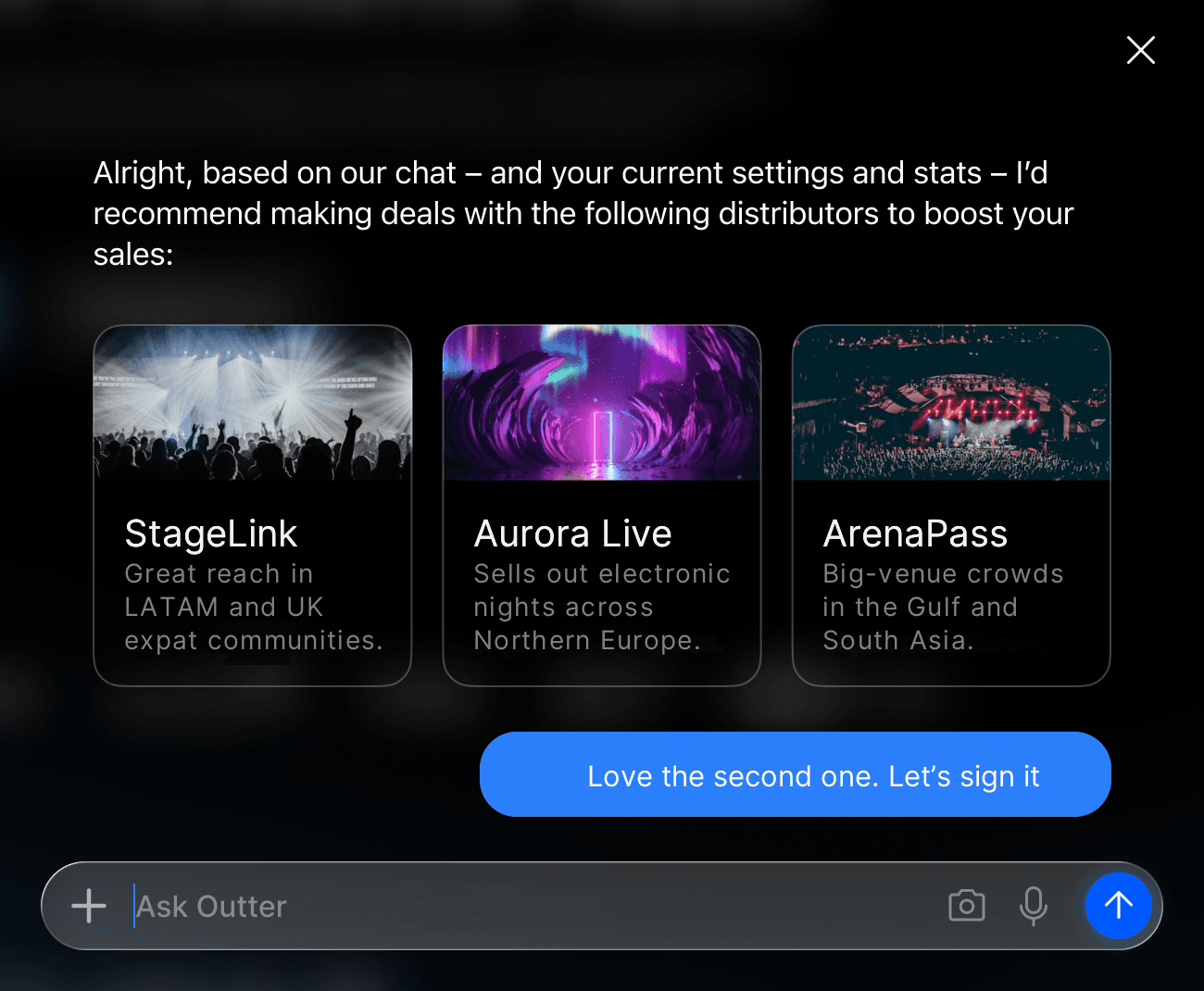
The second decision was about where it lived. Not in a separate tab, not in a bubble in the corner that opens a different world, but inside the screens customers were already using, so that the conversation and the button sat next to each other. That one will matter later in this story.
The third was about getting in. Big companies do not want an AI project, they want a feature by next quarter, and small ones want it by Friday. So we never asked anybody to rebuild their database. For a small business, setting up a co-pilot was four steps: give it what you already have written down, choose the tone of voice, describe the stages your customers go through, paste one snippet of code.2 Larger clients plugged it into the systems they already had, which took a couple of days.
And because every one of those clients was handing us their customers, each one got its own separate environment, hosted in the UK and Europe, with nothing shared between them. “Your data isn’t just protected, it’s separated” was the line.17 For a European company deciding whether to let an AI talk to its customers, that sentence did more work than any feature.
It worked, commercially. Five-figure revenue in eight weeks, a profitable company by the summer, clients onboarded in under two months, and a team in Manchester and Bilbao.17 One client in education handed it a pile of old PDFs and got interactive lessons back within hours.
The product did exactly what we designed it to do. The problem was the person on the other side of it.
The race
Then people used it on their own, on an ordinary day, with nobody demoing. The honest summary of what we learned is that they went looking for the button.
It took me a while to stop being offended and start counting. Try it yourself. Same job, done twice.
- #4098KettleDelivered
- #4127Running shoesArriving Thursday
- #4131Desk lampBeing packed
- #4140Phone caseArriving Friday
Unless you type unusually fast, the conversation lost, and not by a little. The average person types 52 words a minute. That comes from 168,000 volunteers and 136 million keystrokes, and the same study found that typing courses made no difference. On a phone it drops to 36.3 Forty characters is eight to eleven seconds of pure typing, before you have decided what to say, spelled it, and waited for the answer.1
A co-pilot wins when the thing you want is buried six screens deep. For the ten things people do every week, the screen is already open and the button is already under their thumb.
Ask me anything
Speed was half of it. The other half is the empty box.
In 1994 Jakob Nielsen wrote down ten rules for interfaces. Number six is “recognition rather than recall”: show people what they can do, do not make them remember it.4 A chat box is pure recall. Nielsen later called this the articulation barrier, and guessed that only 10 to 20 percent of people write well enough to get much out of a prompt.5 That is his estimate, not a measurement. I would not bet against it.
There is measurement too. In a 2022 experiment, people doing the same task through a chatbot reported less control, more mental effort and less satisfaction than people using a plain menu.6 That was before today’s models, and newer studies are mixed. But we have all watched this film once already, with voice. After a decade of talking speakers, a 2025 survey found the top uses were the weather (59%), music (51%) and timers (40%). Shopping was at 14%.7
The trust gap
Then there is the part no amount of speed fixes. People use AI. They do not trust it yet.8 And they are a long way from handing it their wallet.9
In that last survey, 71% said they would want to review the purchase first.10 Think about what that does to a product like ours. The co-pilot does the thing, and then the customer wants to see for themselves that it did. We had not replaced the button. We had added a step in front of it.
The agents are not quite there either. In a benchmark built from 175 ordinary office tasks, the best agent completed 24% of them, later 30%.11 In June 2025 a large analyst firm predicted that more than 40% of agentic AI projects would be canceled by the end of 2027.12 And a big fintech that had announced its assistant was doing the work of 700 people said a year later that quality had suffered, and went back to hiring humans.13
Good enough
I wanted to end with the keyboard. You know the story: a better layout was invented, and habit killed it. It is the textbook case of people sticking with the worse thing.
It is also mostly a myth. The wartime study that “proved” the better layout was run by the man who held the patent, and a later government test found no advantage at all.14 People did not cling to a bad design. The one they had was good enough, and they already knew where everything was.
In startup post-mortems the most quoted cause of death is “no market need,” named in 42% of one well-known sample.15 I used to read that as: they built something nobody wanted. People wanted what we built. They just did not want it more than a gray rectangle that does one thing, in two and a half seconds, where they can watch it happen.
I still think the conversation wins in the end. Trust goes up, the models get better, and typing is not the only way to talk. But we spent four months building something that could do anything you asked, and what people asked was where the button had gone.
- Card, Moran and Newell, the Keystroke-Level Model, 1980: 1.1 s to point, 1.35 s of mental preparation, 0.2 to 0.28 s per keystroke
- Michael Keeman, “Co-pilots are the missing link in Europe’s AI adoption story,” Startups Magazine, September 2025
- Aalto University and University of Cambridge, typing study of 168,000 volunteers, 2018; and the 2019 follow-up on phones (37,000 volunteers, 36 words a minute)
- Jakob Nielsen, “10 Usability Heuristics for User Interface Design,” 1994
- Jakob Nielsen, “The Articulation Barrier: Prompt-Driven AI UX Hurts Usability,” 2023
- Nguyen, Sidorova and Torres, “User interactions with chatbot interfaces vs. menu-based interfaces,” Computers in Human Behavior, 2022
- YouGov survey of what people use voice assistants for, 2025
- University of Melbourne and KPMG, “Trust, attitudes and use of artificial intelligence: a global study 2025”
- Forrester, “Many UK consumers believe in agentic commerce, but few trust it to make purchases,” March 2025
- US consumer survey on AI agents and shopping, 1,000 respondents, 2025: 1% wanted fully automated buying, 71% wanted to review first
- TheAgentCompany, a benchmark of 175 office tasks for AI agents, Carnegie Mellon University, 2024
- Gartner press release, June 25, 2025
- Entrepreneur, on a fintech chief executive reversing course on AI-only customer service, May 2025
- Liebowitz and Margolis, “The Fable of the Keys” (1990) and “The QWERTY Myth.” Fans of the alternative layout still dispute it
- CB Insights, analysis of 101 startup post-mortems, 2014
- Pew Research Center, “Concern and excitement about AI,” 25 countries, October 2025
- Tech Funding News on Outter, June 2025: actions not answers, separated data, onboarding times, profitability