Unspoken truth about footballers
A professional footballer’s career lasts, on average, less than eight years. That is the players’ own union talking.1
I have been a product manager for about eight years and I still feel like I am getting started. For a footballer that is the whole thing. Final whistle, and you are thirty-something with the rest of your life to fill.
We helped a group of former players in the UK build a product for that day. Before we designed anything, I went looking for the numbers. They were not the numbers I expected.
One in 8,333
Start with who gets to retire from football at all.
About 1.5 million boys play organized youth football in England at any one time. Around 180 of them will become Premier League players. That is 0.012%, or one dot in the picture above.2
It does not get much kinder closer to the top. Of 4,109 boys who came through the elite academies over six birth years, 97% never played a single minute in the Premier League, and 70% never got a professional contract of any kind.2
So the people we were building for had beaten absurd odds. This is the part nobody says out loud. Winning does not set you up.
The famous number
If you know one statistic about retired footballers, it is this one: three in five go bankrupt within five years of their last game.
It was in every article I opened. It comes from a charity for ex-players, which announced it in 2013 and gave its source as “our database.” A newspaper later traced the figure back to an insolvency firm, where it had meant something closer to “run into problems.” The head of the players’ union at the time put real bankruptcy at 10 to 20%.3
American football has the same story with bigger numbers. In 2009 a magazine reported that 78% of players were bankrupt or in financial trouble two years after retiring, quoting unnamed advisers. Economists then followed real players through real court records. Bankrupt after two years: 1.9%. After twelve: 15.7%.4
As a storyteller I was a little disappointed. As a person, relieved. Then I read the quieter numbers, the ones that never make a headline. They come from the global players’ union,5 the English one6 and a study of former players.7
Not bankrupt. Just unprepared, which lasts longer.
The money is misunderstood too. The average wage at the very top is estimated at more than £60,000 a week. But the last time official figures were published for the fourth tier, in 2009–10, the average there was £38,844 a year.8 Most professional footballers are not rich. They are people in their thirties who earned a decent salary for a few years and have no CV.
Thirty-four
Players usually finish somewhere between thirty and thirty-four, and that is the lucky ones. Often they do not get to choose the day. In a study of retired players from the German top flight, 63% had been stopped by injury.9
The last match. Twenty-six years of football behind you, and most of a lifetime of something else in front.
Everything to the left of that pin was organized by somebody else. When to train, what to eat, where to be on Saturday, what to work on this week. It has been that way since they were children.
That is why the money is not really the center of this. Researchers who studied 307 retired professionals in the UK found that the more a man’s sense of himself was built on being a footballer, the more likely he was to be depressed afterwards.10 You do not only lose the job. You lose the answer to “and what do you do?”
What they can do
The product we built with them starts from the opposite end. It does not ask what a player lacks. It uses an AI of its own to analyze what makes him unusually good, shows where those strengths are worth something outside football, and then gets practical: what he still needs before he qualifies, and how to actually land a job he would love.
If that sounds familiar, it is the idea we chased at Hattl. Stop reading the label. The label says “ex-footballer, no qualifications.” Underneath it is someone who has been coached in public since he was a child, has performed on a fixed schedule in front of thousands, and has had his mistakes replayed on television.
- Runs the room without owning it
- Translates between the manager and the dressing room
- Stays civil with referees, press and angry people
- Management basics, on paper
- Experience of leading people who are free to leave
How we built it
The product is really two products, and keeping them apart was the first decision.
One is a career discovery test. Anybody can take it, and most people do it sitting at a laptop. The other is an app just for athletes, which lives on the phone. The obvious move was one account and one login across both. We didn’t, because the test is a door anyone can walk through and the app is a club with a membership, and each needed to be marketed on its own. They are joined by a short code, letters and numbers you can remember long enough to type into your phone, and once it is in, your results are waiting inside the app.
Inside the app sits an AI coach, and most of the design work went into making it behave like a good mentor and not like a chatbot.
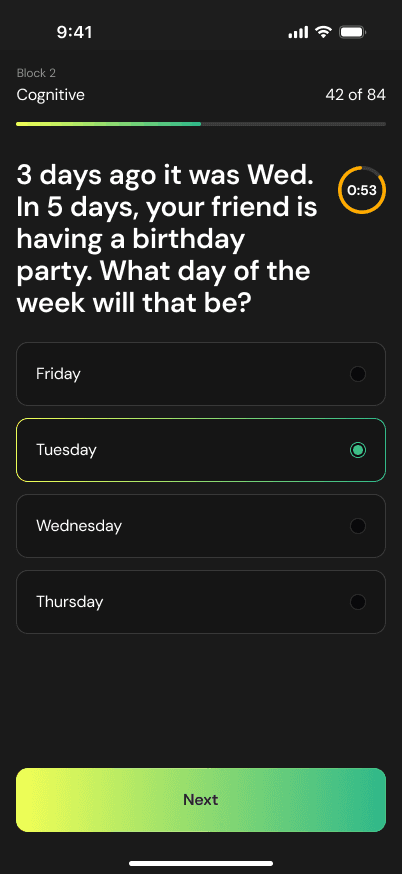
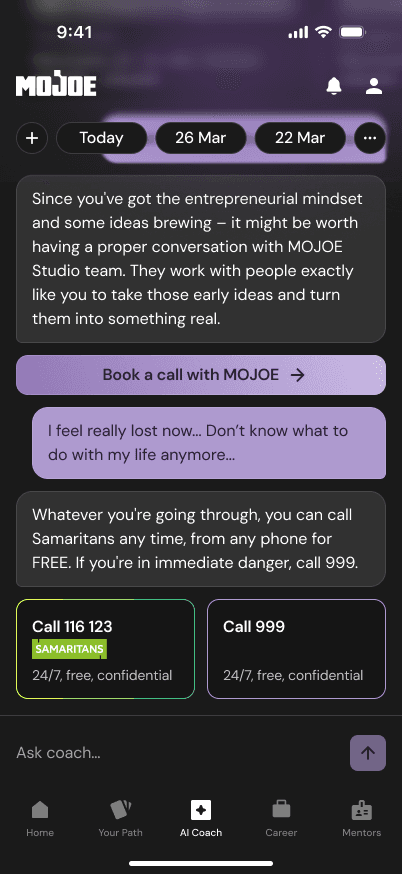
It speaks first. Nobody types “hi” to a blank screen, least of all someone who has just lost their job. So the coach opens the conversation, and its first question is whether you are still playing or have stopped. Retiring by choice and being retired by an injury are different griefs, and the coach should not greet them the same way.
Hard questions come with buttons. Money and injuries are the two subjects players least want to type about. Those questions arrive with ready answers to tap instead of an empty text box.
It knows what you need before it knows what to say. Every reply starts with a decision: does this person need a job, a mentor, something to do this week, or something to read or listen to. There is an order of preference, and if there is no good match at the top it falls to the next. Mentors are tagged by what they can actually help with, and a mentor with no tags is invisible to the coach.
Slow, but honest about it. The coach thinks before it answers, and thinking takes a few seconds. We tried making it faster, and it got faster by getting noticeably dumber. So we kept the brain and changed the wait: a rotating set of small, silly loading phrases that tell you something is happening. It is the labor illusion from my ticketing days, applied to a mentor that needs a moment to think.
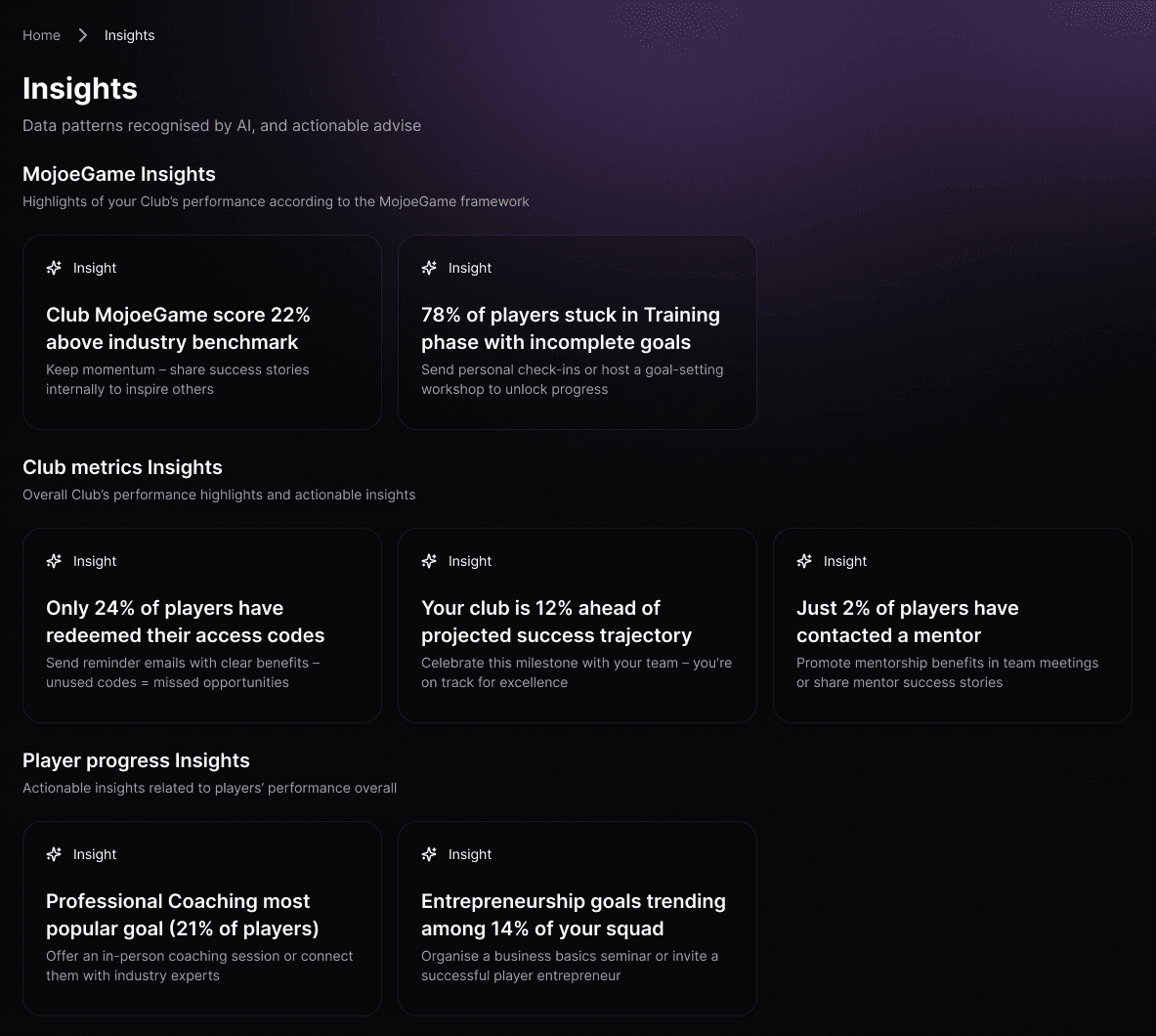
Clubs get the other half. Clubs and associations bring their players in, so they get their own dashboard. It turns the whole squad’s progress into a few plain sentences, each with something to do about it.
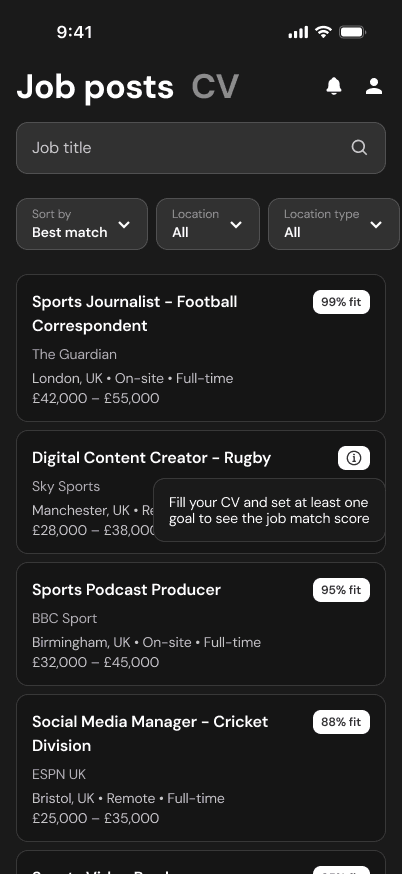
Jobs that are still open. Hand-picked vacancies go stale, and plenty of online listings close after the first hundred applicants. So job matches come from a live feed aggregated across job boards, not from somebody’s spreadsheet.
The world already values this. It just never says so in a job advert. When a survey asked 400 women in executive jobs about their past, 94% had played sport, and more than half of those in the C-suite had played at university level.11
I do not say this about many projects, but we nailed this one.
The unspoken truth about footballers is not that they go broke. Mostly they do not. It is that at thirty-four, for the first time in their lives, somebody asks what they are good at, and nobody ever taught them how to answer. Every sprint and every pass of their working life was recorded. None of it is on a CV.
- Professional Footballers’ Association: the average career lasts less than eight years
- The Irish Times, “Fields of broken dreams,” on Michael Calvin’s estimate (180 of 1.5 million) and on academy outcomes for players born 1995 to 2000
- The Irish Times, 2013, on where the “three in five” bankruptcy claim came from, and the union’s own estimate
- Carlson, Kim, Lusardi and Camerer, “Bankruptcy Rates among NFL Players with Short-Lived Income Spikes,” NBER, 2015
- FIFPRO, “Mind the Gap” survey, 2021
- PFA and the Professional Players Federation, career transition research, 2018
- FIFPRO and Vincent Gouttebarge, study of mental health among current and former players, 2015
- Sporting Intelligence, average wages by English division from the last published PFA figures, 2009–10
- Koch et al., study of 116 retired Bundesliga players, 2021
- Loughborough University research on depression and athletic identity among 307 retired UK professional footballers
- EY and espnW, survey of 400 women executives, 2014