Job search is dead.
Some time in the early 1480s, Leonardo da Vinci asked the Duke of Milan for a job. The letter is often called the first CV. It is mostly about military engineering, and his art only gets a mention at the very end. He probably did not even write it himself: the surviving draft is in somebody else’s hand.1
Five hundred years on, the format has barely moved. A page of claims, tuned for whoever is reading. The one real change is that the first reader is no longer a duke.
Seven seconds
When a human does look, they do not look for long. One eye-tracking study of recruiters clocked the first pass over a CV at 7.4 seconds.2
This is what that is like from the other side of the desk.
You are the recruiter. There are a few hundred more of these behind it.
Most CVs do not get even that. Some kind of filtering software sits in front of 97 to 98% of the five hundred largest American companies.3 When Harvard Business School surveyed 2,250 executives, 88% of them said their own filters reject qualified people for not matching the exact criteria.4
So candidates adapted. They apply to everything, and they decorate: in one poll, 70% admitted to lying on a CV.5 Companies returned the favor. In another survey, roughly four in ten hiring managers said their company had advertised a job that did not exist.6
What predicts anything
Underneath all that sits a quieter problem. The CV is organized around the wrong things.
Psychologists have spent about a century measuring which hiring signals tell you how someone will actually do in a job. The big summary was redone in 2022, and it was not kind to the classics.
Years of experience, the spine of every CV ever written, comes in at .07. That is close to noise. What a person is interested in predicts more than three times as much.7
And when the match is wrong, nobody enjoys it. The largest global survey of working life puts the share of people who are engaged in their job at 23%.8
From games to jobs
In 2022 my co-founder and I ran a start-up that recommended video games. It matched people to games by why they play, whatever the label on the box said, and it did not survive. The idea did.
The second Hattl does for jobs what the first one tried to do for games. It does not scan a CV for keywords, and the CV is not what we score. A candidate spends under five minutes on a short, game-like assessment that mixes projective psychology with the skills of the role.9 What comes out is a picture of who they are: what they like, how they decide, what kind of place they come alive in. From the company we want the thing a job ad never tells you, which is the attitude and mindset that actually do well there.
Then we match the two. The line on the front page is “when the job and the candidate fit.”
How a match is made
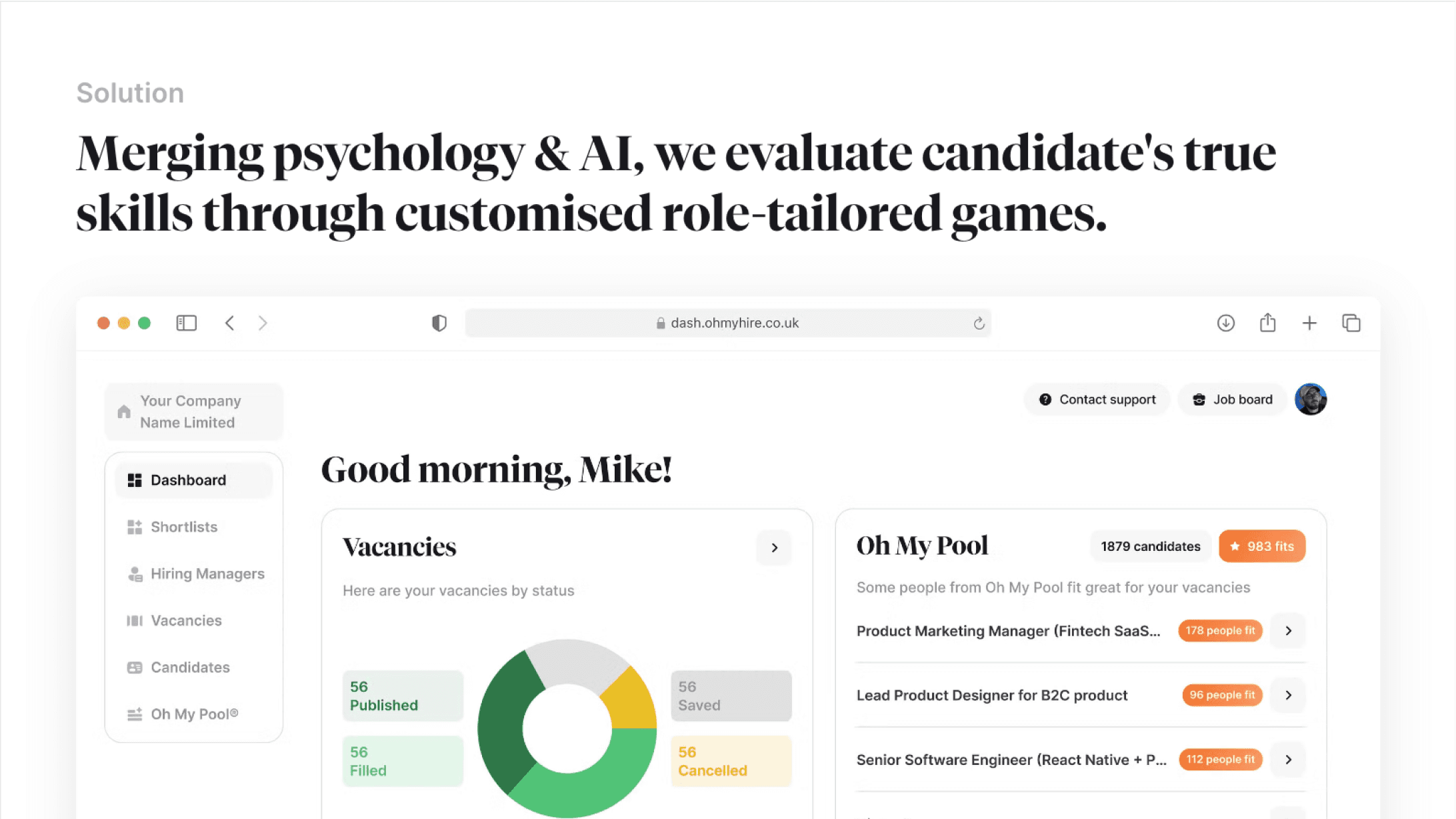
There is no generic Hattl test. Every assessment is built for one role at one company, and it starts from the hiring manager’s own notes and requests, the things that never make it into a job ad.9
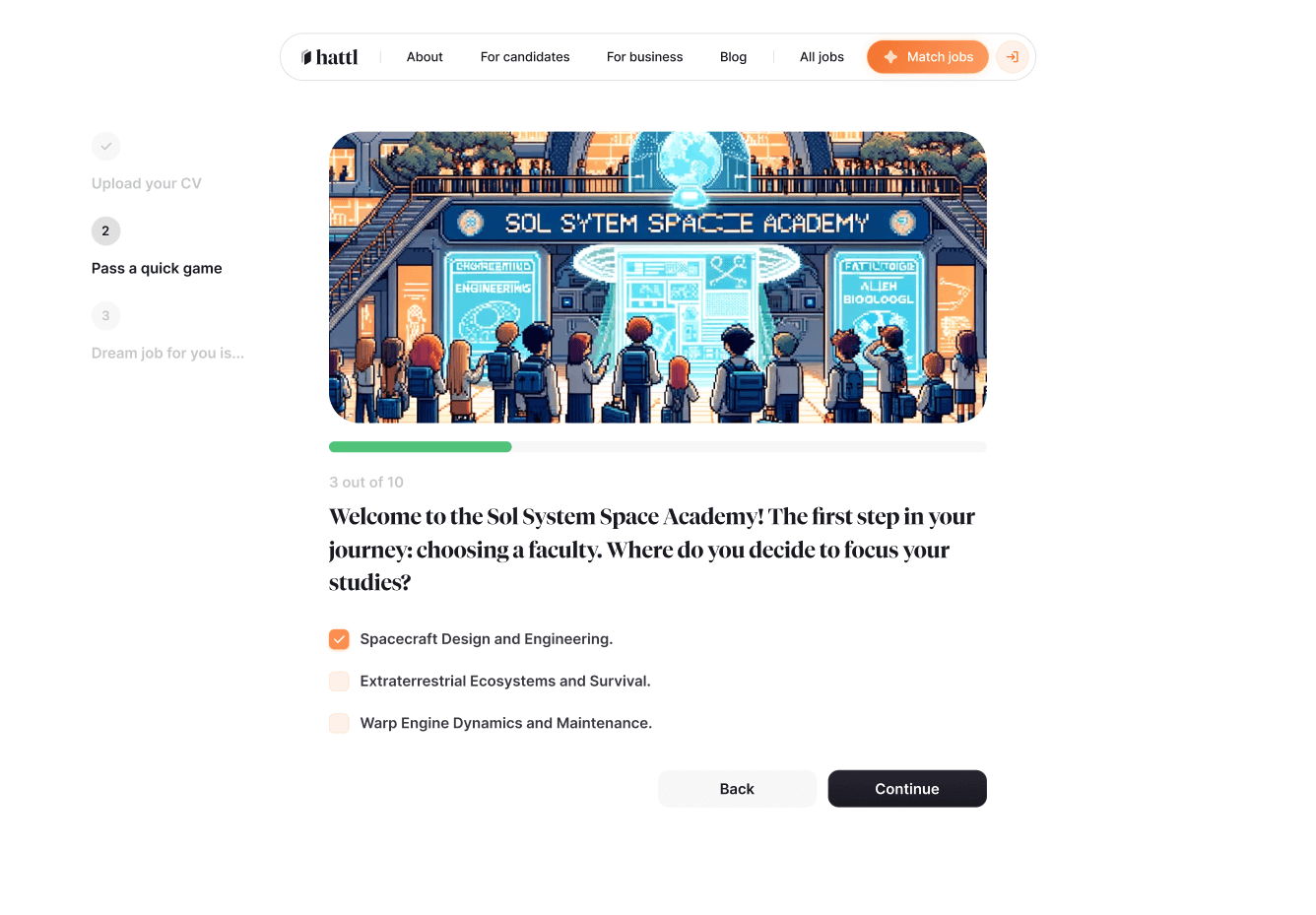
The candidate then plays. Each game mixes two things. One is projective psychology, the old trick of showing someone an ambiguous situation and learning about them from how they read it: nobody can tell you how they handle ambiguity, but everybody shows you. The other is a plain check of the skills the role needs. The whole thing takes under five minutes, which matters more than it sounds. The people you most want to hire are the ones with the least patience for a ninety-minute questionnaire.
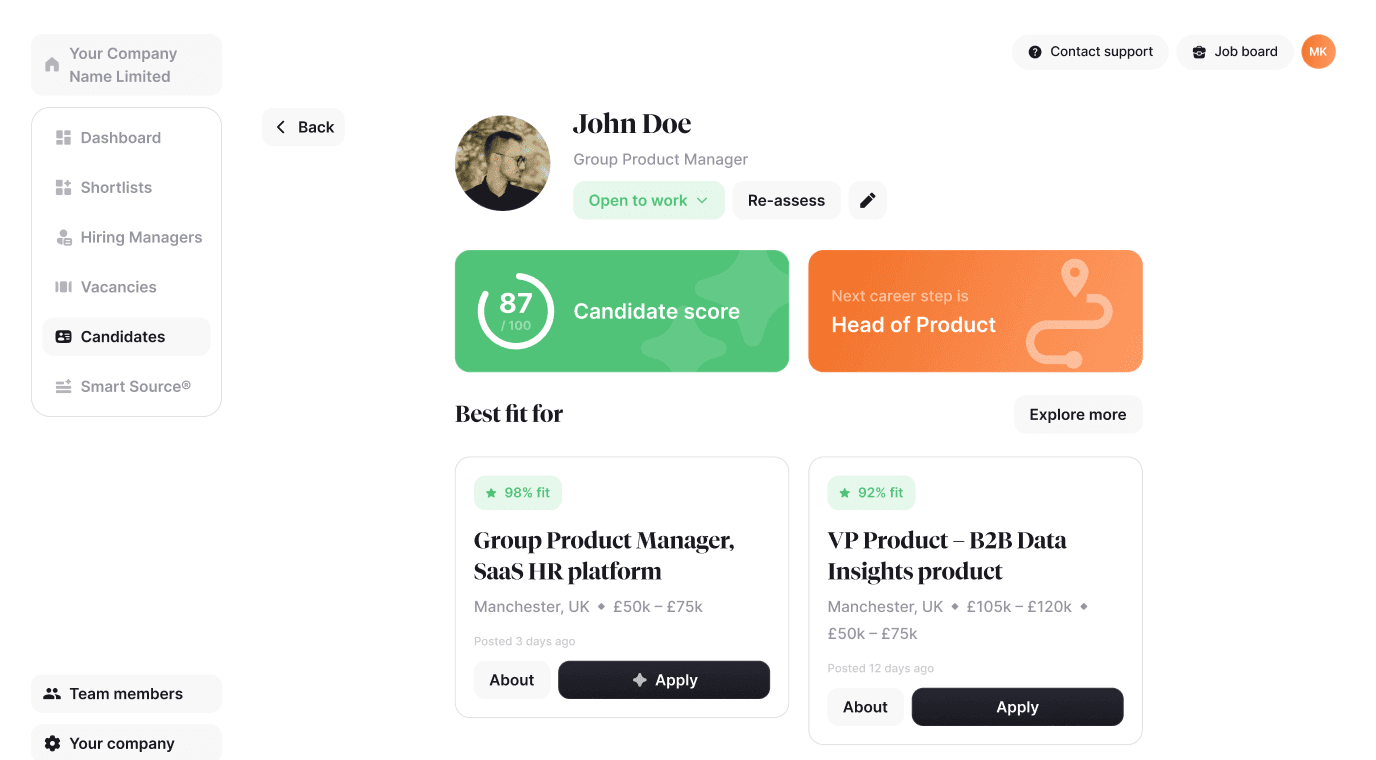
Last comes the engine. It reads everything together, the role’s context, the meaning of the answers rather than their keywords, and the profile, and turns it into a single fit score.9
Explaining a number
A score on its own is useless to a hiring manager. “This candidate is 82%” invites exactly one question, eighty-two percent of what, and if you cannot answer it in a sentence the manager goes back to reading CVs.
So the hardest design problem we had was not the model. It was taking an algorithm that weighs psychology, skills and context at once, and putting it on a screen in a way a busy person understands at a glance and believes. When we launched, the comment I was happiest to read was that the product felt simple.
I cannot embed the real thing here, so this is a toy in its spirit.
One caution, since I have just shown you a chart about evidence. Game-based assessment is young. In one large study, a game-based test agreed reasonably well with a traditional one, but proof that such scores predict performance in the job is still thin.10 “Who are you” is a better question than “how many years.” It is not yet a solved one.
Good riddance
Search is what you do when all you have is keywords and hope. Both sides of hiring have become very good at keywords, which is exactly why the keywords have stopped meaning anything.
What comes next looks less like a search and more like an introduction. This person, this team, and a reason.
Job search is dead. I do not think anybody will miss it.
- Leonardo da Vinci, draft letter to Ludovico Sforza, Codex Atlanticus f. 1082r, Biblioteca Ambrosiana
- HR Dive on the 2018 eye-tracking study of recruiters (the study does not disclose its sample size)
- Jobscan’s yearly count of applicant tracking systems at Fortune 500 companies
- HR Dive on “Hidden Workers: Untapped Talent,” Harvard Business School and Accenture, 2021
- Fortune on a 2023 poll of 1,900 US workers about lying on CVs
- KTVU on “ghost jobs,” including a 2024 survey of 649 hiring managers
- HumRRO on Sackett, Zhang, Berry and Lievens (2022), revisiting Schmidt and Hunter (1998)
- Gallup, State of the Global Workplace
- Hattl on Product Hunt
- A 2022 validation study of a game-based cognitive assessment, Frontiers in Psychology
- eWeek on the volume of job applications in 2025, citing The New York Times