Product managers should drink
There is a pub in the middle of Manchester whose building went up in 1552. It did not become a pub until 1830. In 1971 it was jacked up a meter and a half, in 1996 it was damaged by a bomb, and by 1999 it had been taken apart and rebuilt three hundred meters down the road.1
This city will move a pub before it closes one.
So when I started a community for product people here, there was never much doubt about where it would meet.
No stage
Product Crawl is a pub crawl for people who build products. That is the whole format. No stage, no speakers, no slides, no agenda. Nobody facilitates anything. There is no icebreaker, no name-badge game, no “now turn to the person on your left.” A few pubs, a route between them, drinks, and whatever idea somebody cannot stop talking about that week.
That was the one real design decision, and it took the most nerve. Every instinct you have as an organizer says to add structure. A short talk to get people in the door, a panel, at least a round of introductions. I left all of it out. The event does exactly two things: it gives people a reason to be in the same room, and it gives them the conditions to think boldly. The second one comes in pints.
The invitation says it better than I can: “Have a couple of pints and create something people love.”
I have nothing against a good talk. But look at what a stage does to a room.
One person talks and everybody else waits for the networking part. Then the networking part is twenty minutes long and happens next to the coats.
A pub does the opposite, and there is a number for it. Researchers who listened in on people talking found that a single conversation holds about four people before it splits in two.2 Put a hundred people in a pub and you do not get an audience. You get twenty-five conversations, and every one of them can be joined, left, or carried to the next bar.
Four, then five hundred
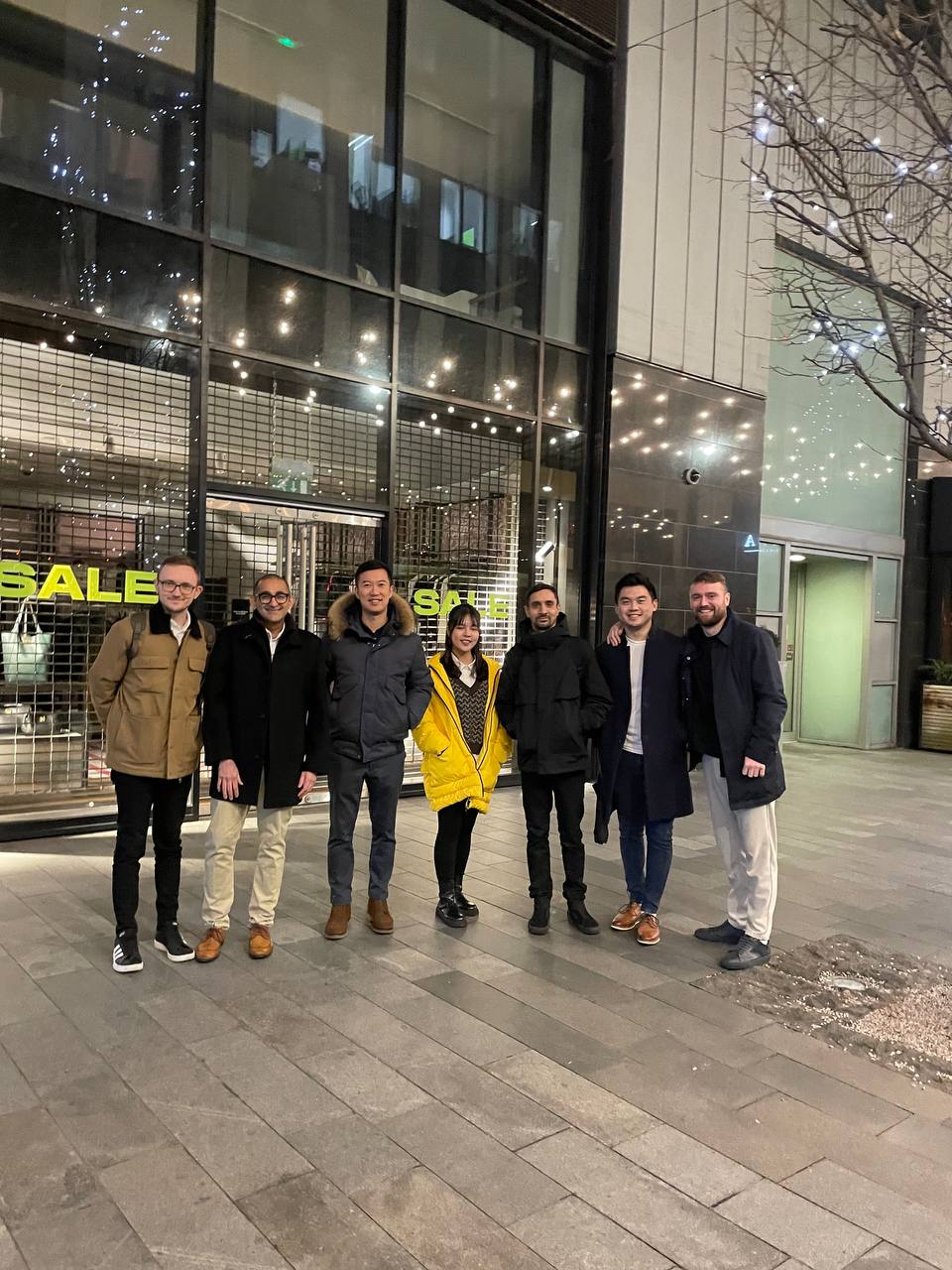
It started with four of us.
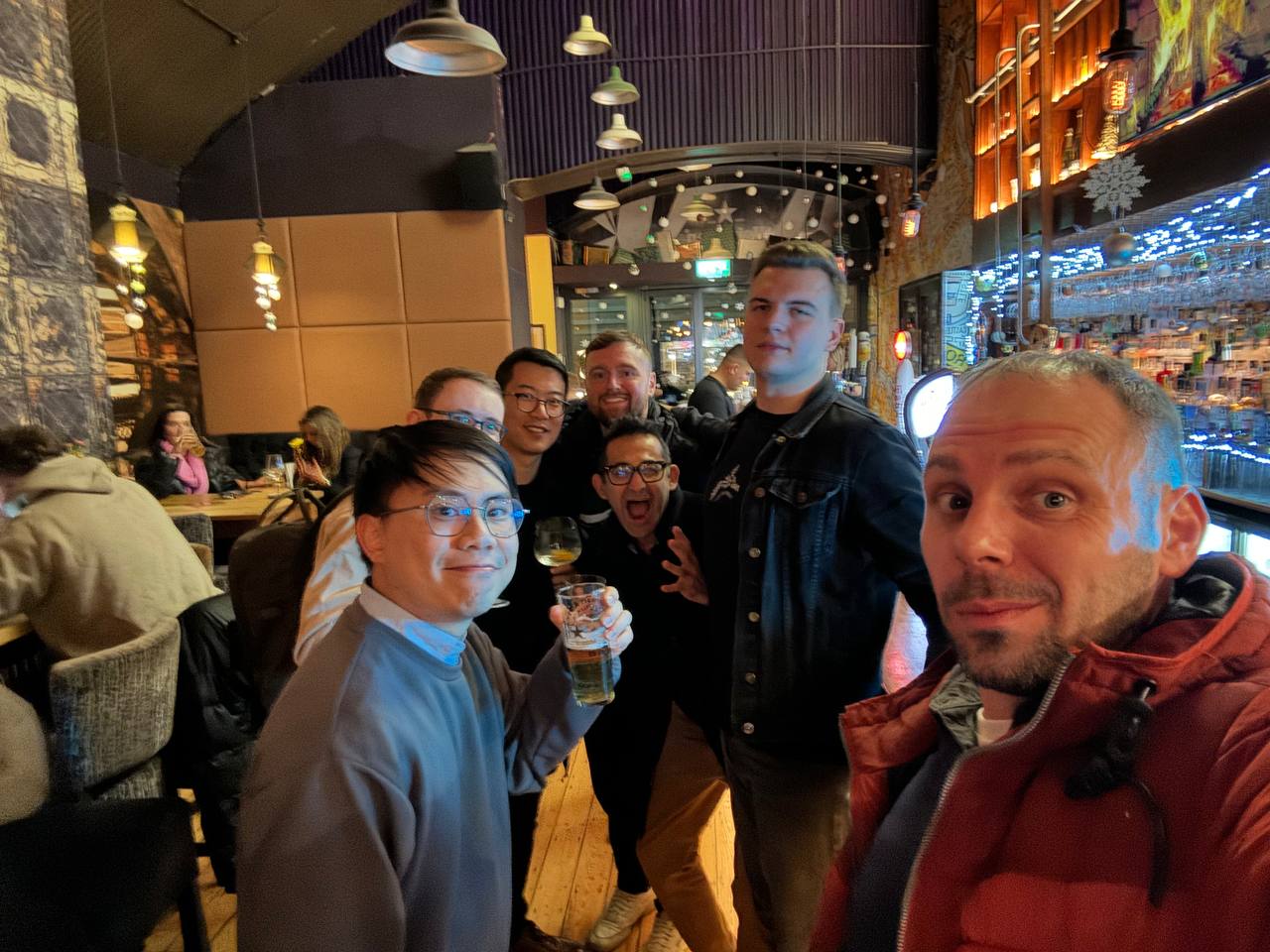
Two months later the community had almost five hundred members, and the biggest nights had up to a hundred people moving between pubs. None of that came from marketing. It was word of mouth, one person bringing a colleague, the colleague bringing their team the next month. When the format is “come and talk to people like you,” every guest is also the advert.
I call it the fastest-growing community in the North-West. Nobody has sent me a counter-example yet.
Some of this is simply the city. Manchester has been ranked the top tech city in the UK outside London,3 with around 658 high-growth companies employing more than 40,000 people.4 That is a lot of people who build things for a living and would quite like to complain about roadmaps to someone who understands.

The sociologist Ray Oldenburg had a name for where that happens. The third place, after home and work, where you find the “regular, voluntary, informal, and happily anticipated gatherings” of people.5 Britain already built about forty-five thousand of them. It closed 509 in 2023 alone.6
The science, sort of
The title needs defending, so here is the evidence, in descending order of seriousness.
A study of 20 million people on the world’s biggest professional network found that new jobs come mostly through moderately weak ties: people you know a little, with about ten connections in common.7 A pub full of people from your field whom you have met twice is, statistically, a job machine.
An Oxford study found that people who have a local pub have more close friends, and are happier and more trusting, than people who do not. It was commissioned by a real-ale campaign, so add salt.8
In 2012, researchers got a group of men mildly drunk on vodka and gave them creative word puzzles. The tipsy group solved 58% of them. The sober group solved 42%, and took longer.9 The tipsy group was also worse at remembering things. The whole study was forty men, which is a stag do, not a clinical trial.
And xkcd once charted the “Ballmer Peak”: a blood alcohol level between 0.129% and 0.138% that grants superhuman programming ability.10 That one is a joke. Please do not cite it in a retro.
You don’t have to
About the drinking. One in five adults in England did not have a single drink in 2022, and among 16 to 24-year-olds it is closer to one in four.11 Plenty of them go to pubs anyway.
The drink is an excuse to stand up, hold something, and talk to a stranger. Lime and soda works. So does coffee. Nobody checks what is in your glass.
The word itself is younger than it feels. “Pub-crawl” first turns up in print in 1915, in a book about London nights: “We did a ‘pub-crawl’ in Commercial Road and East India Dock Road.”12 The practice, I suspect, is exactly as old as the second pub.
Product managers should drink. Lager, tea, tap water, I do not mind. They should do it standing up, in a room with no stage, next to somebody they have not met yet.
- The Old Wellington Inn, Manchester: built 1552, licensed 1830, raised in 1971, rebuilt by November 1999
- Dunbar, Duncan and Nettle, “Size and structure of freely forming conversational groups,” Human Nature, 1995
- TheBusinessDesk, “Manchester retains place as UK’s top tech city outside London,” March 2022
- UKTN regional tech report on Greater Manchester, July 2023
- Ray Oldenburg and the “third place” (The Great Good Place, 1989)
- The Morning Advertiser on UK pub numbers and closures in 2023; and on the price of a pint, August 2023
- MIT News on Rajkumar et al., “A causal test of the strength of weak ties,” Science, 2022
- Robin Dunbar’s “Friends on Tap” research for the Campaign for Real Ale, 2016
- British Psychological Society digest of Jarosz, Colflesh and Wiley, “Uncorking the muse,” 2012
- xkcd 323, “Ballmer Peak”
- Health Survey for England 2022: adult drinking
- Pub crawl: first printed use in Thomas Burke’s Nights in Town (1915), and the 2009 record